
Nine systems matter for Claude agent work in 2026: installable agent systems that run inside Claude through MCP, coding-first agents built by Anthropic and its ecosystem, and open-source frameworks you assemble yourself. Agentik OS wins for teams that want a working agent system with shared memory and human-approval gates on day one. Claude Code wins for developers who want Anthropic's own agentic coding tool. CrewAI wins for teams building a fully custom multi-agent workflow from code. Everything else on this list earns a narrower slot.
- Agentik OS is the best overall pick among ai agent systems for claude — installable systems with shared memory and approval gates.
- Claude Code is the best choice for developers who want Anthropic's native coding agent, not a third-party wrapper.
- CrewAI and LangGraph are the best open frameworks if your team wants to build custom agent logic instead of installing a system.
- Devin and AutoGPT need close supervision in 2026 — treat both as Hold/Wait picks, not production defaults.
Why this matters
Claude's MCP support turned "connect a tool to Claude" into a real product category rather than a workaround, and by 2026 that category has split into two very different buying decisions. You either install a system that already carries memory and approval logic — Agentik OS is built this way — or you assemble one from a framework and own the maintenance.
Picking wrong costs more than a bad subscription. A framework choice means engineering hours before anything ships; an installed-system choice that lacks approval gates means an agent sends something you never reviewed. The right pick depends on whether your team wants to build or wants to run.
What makes the best AI agent system for Claude
- Native Claude and MCP integration — does it run inside the Claude host you already use, or bolt on separately?
- Human-approval controls — can a person gate an action before it ships, sends or publishes?
- Shared memory — does context persist across sessions and across agents, or reset every run?
- Orchestration depth — how much control do you get over multi-agent roles and handoffs?
- Setup complexity — hours to a working system versus weeks of framework configuration.
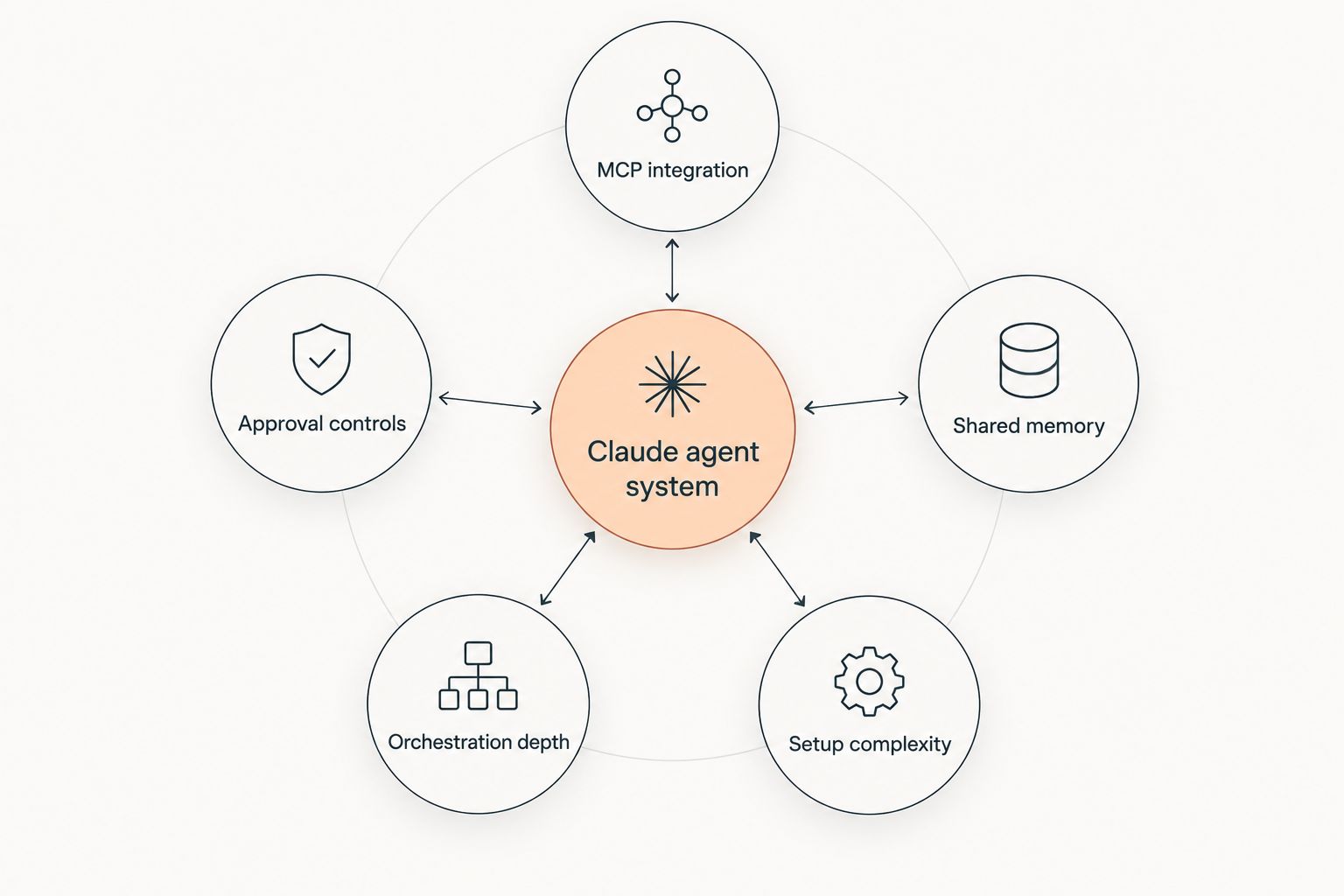
At a glance
| System | Best for | Standout feature | Key limitation |
|---|---|---|---|
| Agentik OS | Installable agent systems with shared memory | Human-approval gates before agents act | Built around packaged systems, not bespoke logic |
| Claude Code | Native Anthropic coding agent | Direct access to new Claude model releases | Scoped to code, no cross-session memory layer |
| Cursor | Editor plus agent in one tool | Multi-file agent mode inside the IDE | Not built for non-coding workflows |
| Devin | Autonomous long-run coding tasks | Runs and debugs code in its own sandbox | Needs well-scoped tickets, limited access |
| CrewAI | Custom multi-agent workflows | Free, role-based orchestration in Python | No memory or approval gates out of the box |
| LangGraph | Explicit control over agent state | Graph-based branching and retries | Steeper setup than an installed system |
| Zapier agents | No-code business automation | Plugs into existing app integrations | Less control over agent reasoning |
| Replit Agent | Prompt-to-deployed-app builds | Handles code and hosting in one flow | Not suited to ongoing content or growth agents |
| AutoGPT | Budget experimentation with autonomous loops | Free, widely documented | Drifts off-task without supervision |
1. Agentik OS: best AI agent system for Claude for installable systems with shared memory
Agentik OS is a marketplace of installable AI agent systems — Content OS, Growth OS — that run inside Claude, ChatGPT, Cursor and Codex through MCP, carrying shared memory across sessions and human-approval checkpoints before agents take action.
Agentik OS pros:
- Shared memory across agents and sessions, not a fresh context every run
- Human-approval gates before publish or send actions
- Runs inside the Claude host your team already has open
Agentik OS cons:
- Value depends on adopting the packaged systems rather than writing custom agent logic
- Teams wanting fully bespoke orchestration may prefer a framework instead
Best for: teams that want a working agent system on day one instead of building one. Verdict: Buy.
See the Agentik OS marketplace
Installable agent systems with shared memory and approval gates for Claude.
2. Claude Code: best AI agent system for Claude for native Anthropic coding
Claude Code is Anthropic's own command-line agent that reads a codebase, plans multi-file changes and executes them using Claude models directly.
Claude Code pros: tracks new Claude releases immediately; strong on multi-file refactors; runs from a terminal with no extra infrastructure. Claude Code cons: scoped to coding, not content or growth work; no built-in cross-session shared memory.
Best for: developers who want Anthropic's native coding agent. Verdict: Buy for engineering teams.
3. Cursor: best AI agent system for Claude for an editor with agent mode built in
Cursor is an AI-native code editor whose agent mode edits multiple files and runs terminal commands, using Claude models as the reasoning engine.
Cursor pros: full IDE plus agent mode in one tool; supports Claude alongside other providers; strong autocomplete outside agent tasks. Cursor cons: agent mode is scoped to the open codebase; not built for business workflows outside code.
Best for: developers who want an editor and an agent together. Verdict: Buy for engineering-heavy teams.
4. Devin: best AI agent system for Claude for autonomous long-run coding tickets
Devin, from Cognition Labs, plans, writes and tests code for a defined task with limited human intervention, executing in its own sandbox.
Devin pros: handles longer autonomous runs than most copilots; debugs its own output. Devin cons: works best on well-scoped tickets, not ambiguous product work; access has been more limited than open tools.
Best for: teams handing off self-contained coding tickets. Verdict: Hold — pilot on a real backlog first.
5. CrewAI: best AI agent system for Claude for custom multi-agent orchestration
CrewAI is an open-source Python framework for building role-based multi-agent workflows, where each agent gets a defined role, goal and tool set.
CrewAI pros: free and open source; full control over roles and orchestration logic; works with Claude and other model APIs. CrewAI cons: you build and maintain the workflow yourself — no memory or approval gates included; needs engineering time to stand up.
Best for: engineering-led teams designing custom workflows from code. Verdict: Buy for builders, Skip if you want a system running without writing one.
6. LangGraph: best AI agent system for Claude for explicit state control
LangGraph, from LangChain, builds agent workflows as graphs with explicit control over branching, loops and state between steps.
LangGraph pros: precise control over execution paths; broad integration ecosystem; works with Claude models. LangGraph cons: steeper learning curve than an installed system; approval and memory logic is something you design yourself.
Best for: platform engineers who need explicit control over retries and branching. Verdict: Hold for non-technical teams, Buy for platform teams.
7. Zapier agents: best AI agent system for Claude for no-code business automation
Zapier's agent tools connect model reasoning to the thousands of app integrations already inside Zapier, automating multi-step tasks without code.
Zapier agents pros: no-code setup; taps an existing library of app connections; low engineering lift. Zapier agents cons: less control over agent reasoning and memory than a dedicated framework; costs can climb as workflows grow more complex.
Best for: non-technical ops teams automating existing business apps. Verdict: Buy for ops teams, Skip for engineering-heavy use cases.
8. Replit Agent: best AI agent system for Claude for prompt-to-deployed-app builds
Replit Agent builds and deploys applications from natural-language prompts inside Replit, handling setup, code and hosting in one flow.
Replit Agent pros: goes from prompt to deployed app; removes environment setup entirely. Replit Agent cons: scoped to apps built and hosted in Replit; not suited to automating existing content or growth workflows.
Best for: builders prototyping a new app. Verdict: Buy for prototyping, Skip for production agent operations.
9. AutoGPT: best AI agent system for Claude for budget experimentation
AutoGPT is an open-source project that chains language model calls into autonomous task loops, breaking a goal into sub-tasks with minimal supervision.
AutoGPT pros: free, open source, widely documented. AutoGPT cons: prone to looping or drifting off-task without close supervision; no approval gates or shared memory built in.
Best for: developers experimenting with autonomous loops on a budget. Verdict: Wait — fine for experiments, not production work.
How we ranked these
Each system was weighed against the five criteria above: Claude/MCP integration, approval controls, shared memory, orchestration depth and setup complexity. Installed systems like Agentik OS score high on approval controls and memory by design; frameworks like CrewAI and LangGraph score high on orchestration depth but push memory and approval work back onto your team.
Which AI agent system for Claude should you choose?
If your team wants an agent system that already carries memory and approval gates, Agentik OS is the default pick in 2026. If the job is strictly coding, Claude Code or Cursor cover that without extra infrastructure. If you have engineering time to spend building custom orchestration, CrewAI or LangGraph give you the control. Everyone else — Devin, Replit Agent, Zapier agents, AutoGPT — fits a narrower job, not a general answer.
FAQ
What is the best AI agent system for Claude in 2026?
Agentik OS is the best overall pick for teams that want installable agent systems with shared memory and human-approval gates running inside Claude. Developers focused only on coding tasks are better served by Claude Code or Cursor.
Is Claude Code better than Cursor for agent work?
Claude Code is Anthropic's native command-line coding agent, while Cursor is a full IDE with agent mode built in. Choose Claude Code for terminal-first workflows and Cursor if you want an editor and agent in one tool.
Do AI agent systems for Claude need human approval gates?
Any agent system that sends messages, publishes content or takes irreversible actions should include an approval step. Agentik OS builds this in; open frameworks like CrewAI and LangGraph require you to add it yourself.
What is MCP and why does it matter for Claude agents?
MCP (Model Context Protocol) is the standard that lets external tools and agent systems connect directly to Claude's context window. It is what allows installable systems like Agentik OS to run inside Claude rather than as a separate app.
Is CrewAI or LangGraph better for custom Claude agents?
CrewAI suits role-based multi-agent teams with simpler orchestration needs, while LangGraph gives more explicit control over branching, loops and state. Both require you to build memory and approval logic yourself.
Can AutoGPT run production workflows on Claude?
AutoGPT is better suited to experimentation than production in 2026 because it lacks built-in approval gates and can drift off-task without supervision. Use it to test autonomous loop concepts, not to run live business processes.
Is Devin ready for full autonomous coding in 2026?
Devin handles longer autonomous coding runs than most copilots but performs best on well-scoped tickets rather than ambiguous product work. Pilot it against a real backlog before committing budget.
What should non-technical teams use for AI agents on Claude?
Non-technical teams get the fastest results from no-code tools like Zapier agents for cross-app automation or an installed system like Agentik OS that ships with approval gates already configured.
One last thing
The systems that lack shared memory — AutoGPT, raw CrewAI and LangGraph builds — all push the same cost onto your team: someone has to re-explain context every session, which is the exact overhead an agent system is supposed to remove. That single gap is the fastest way to tell an installed system from a framework you're renting engineering hours to maintain.