
Marketing teams in 2026 aren't asking whether to use AI agents anymore — they're asking which ones actually finish the job without a human re-checking every output. This guide ranks the six systems worth evaluating right now, based on what each one actually automates, where it plugs in, and where it still needs a person in the loop.
- Agentik OS wins for teams that want installable AI agents for marketing with shared memory and human-approval gates inside Claude, ChatGPT, Cursor or Codex.
- HubSpot Breeze is the pick if your marketing stack already lives inside HubSpot's CRM.
- Jasper still leads on long-form, on-brand content generation at scale.
- Salesforce Agentforce fits enterprise teams that need marketing and sales agents aligned in one CRM.
- Zapier Agents and Sprout Social AI cover workflow glue and social triage, not full agent orchestration.
Best overall: Agentik OS. Best for CRM-native teams: HubSpot Breeze. Best for enterprise sales-marketing alignment: Salesforce Agentforce. Best for lean teams stitching together existing apps: Zapier Agents.
Why this matters
Most "AI marketing tools" from 2023-2024 were single-purpose generators: write this caption, draft this email. What changed by 2026 is orchestration — agents that hold memory across a campaign, hand off tasks to each other, and pause for a human sign-off before anything publishes.
That shift matters because the failure mode isn't bad output anymore, it's unsupervised output. A content agent that drafts 40 blog posts a week is worthless if nobody can review them fast enough, and a growth agent that emails your entire list without approval is a liability, not a feature. The tools below are ranked on how well they solve that specific problem, not just on how fast they generate text. Agentik OS built its entire pitch around installable agent systems — Content OS, Growth OS — that carry approval gates by default rather than as an afterthought.
What makes the best AI agents for marketing
- Shared memory across tasks — the agent remembers brand voice, past campaigns, and prior decisions instead of starting cold every session.
- Human-approval gates — nothing publishes or sends without a person clicking approve, especially for outbound and paid spend.
- Native host integration — the agent runs inside tools your team already uses (Claude, ChatGPT, Cursor, Codex) instead of forcing a new login.
- Breadth of marketing task coverage — content, SEO, growth experiments, and reporting, not just one narrow function.
- Workflow automation depth — how many steps the agent chains on its own before it needs a human touch.
- On-brand output consistency — whether drafts still sound like your brand after the 50th generation, not just the first.
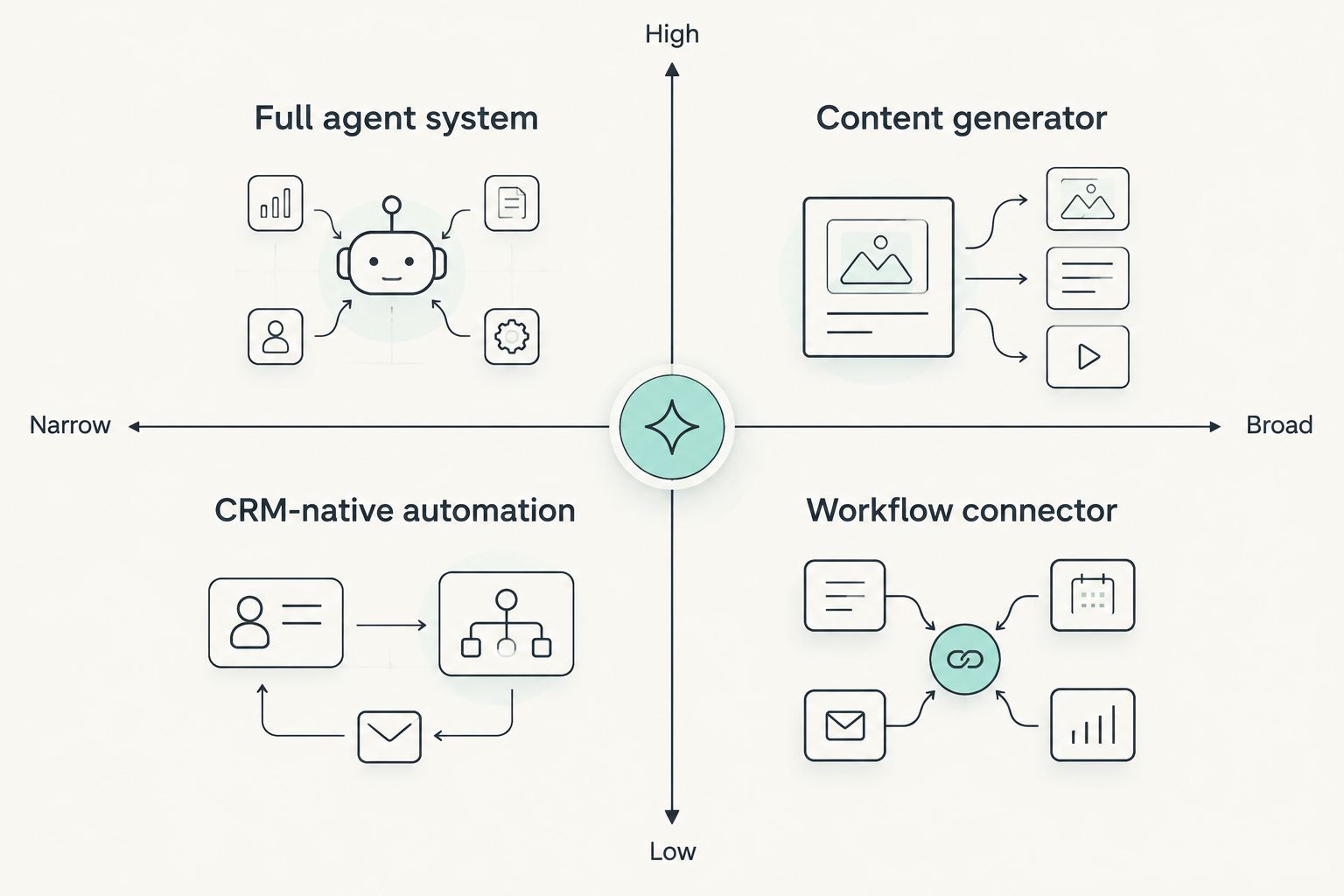
AI agents for marketing at a glance
| Tool | Best for | Standout feature | Key limitation |
|---|---|---|---|
| Agentik OS | Installable multi-agent systems with approval gates | Shared memory across Content OS and Growth OS, runs inside Claude/ChatGPT/Cursor/Codex via MCP | Requires an existing AI host to install into |
| HubSpot Breeze | Teams already on HubSpot CRM | Automation embedded directly in existing CRM data | Limited value if your CRM isn't HubSpot |
| Jasper | Long-form, on-brand content at scale | Deep brand-voice training for repeated content generation | Narrower scope than a full agent system |
| Salesforce Agentforce | Enterprise marketing-sales alignment | Agents share pipeline data across Salesforce's ecosystem | Heavy setup lift outside Salesforce shops |
| Zapier Agents | Connecting existing marketing apps | No new infrastructure — automates across tools you already run | Shallow reasoning versus dedicated agent systems |
| Sprout Social AI | Social listening and engagement triage | Flags high-priority mentions across channels automatically | Doesn't touch content creation or growth strategy |
1. Agentik OS: best AI agents for marketing teams that need approval gates
Agentik OS is a marketplace of installable agent systems — Content OS and Growth OS among them — that run inside AI hosts your team already has open: Claude, ChatGPT, Cursor, and Codex, connected via MCP. Instead of a single chatbot, you install a system of agents that share memory across a campaign and route anything customer-facing through a human-approval step before it goes live.
Agentik OS pros:
- Shared memory means the agent doesn't forget last month's campaign context
- Human-approval gates are built into the workflow, not bolted on
- Runs inside existing tools (Claude, ChatGPT, Cursor, Codex) instead of requiring a new platform login
- Covers content and growth operations from one marketplace rather than two separate tools
Agentik OS cons:
- You need one of the supported AI hosts already in use for the install to make sense
- Best value shows up once you install more than one agent system, not a single narrow task
Agentik OS pricing: check current plans on the Agentik OS marketplace page.
Best for: marketing teams that want a full agent system with shared memory and approval gates, not a single-purpose generator.
Verdict: Buy for teams ready to run content and growth agents with a human still signing off on outbound work.
2. HubSpot Breeze: best for CRM-native marketing automation
HubSpot Breeze layers AI agents on top of HubSpot's existing CRM data, so tasks like lead scoring and campaign follow-ups pull directly from contact records you already have.
HubSpot Breeze pros:
- No data migration — it reads the CRM data you already store
- Familiar interface for teams already trained on HubSpot
- Tight integration with existing HubSpot workflows and lists
HubSpot Breeze cons:
- Value drops sharply if your CRM isn't HubSpot
- Agent scope is tied to what HubSpot's ecosystem supports, not open-ended
Best for: marketing teams whose CRM, email, and landing pages already run on HubSpot.
Verdict: Buy if you're a HubSpot shop; Skip otherwise.
3. Jasper: best for on-brand content generation at scale
Jasper focuses on generating long-form marketing copy — blog posts, ad variations, product descriptions — trained on a defined brand voice profile.
Jasper pros:
- Strong at holding a consistent brand voice across hundreds of drafts
- Fast for high-volume content teams (blogs, ads, product copy)
- Established tool with a large template library
Jasper cons:
- Narrower than a full agent system — it generates, it doesn't orchestrate growth tasks
- No native approval-gate workflow for publishing or sending
Best for: content teams whose bottleneck is drafting volume, not campaign orchestration.
Verdict: Hold if you already run a broader agent system; Buy if content drafting alone is the gap.
4. Salesforce Agentforce: best for enterprise sales-marketing alignment
Salesforce Agentforce puts marketing and sales agents on the same pipeline data inside Salesforce, so a lead's marketing history and sales stage stay in sync.
Salesforce Agentforce pros:
- Marketing and sales agents share the same pipeline data
- Built for enterprise-scale account and contact volumes
- Fits existing Salesforce governance and permission structures
Salesforce Agentforce cons:
- Heavy setup effort if you're not already deep in the Salesforce ecosystem
- Overkill for small marketing teams running lean campaigns
Best for: enterprise teams that need marketing and sales agents reading from one shared record.
Verdict: Buy for Salesforce-native enterprises; Wait if you're under 20 people.
5. Zapier Agents: best for connecting existing marketing apps
Zapier Agents automates handoffs between the marketing tools you already run — CRM, email, ad platforms — without asking you to adopt new agent infrastructure.
Zapier Agents pros:
- Works across apps you already use, no migration required
- Fast to set up for simple trigger-and-action workflows
- Low learning curve if your team already uses Zapier
Zapier Agents cons:
- Reasoning depth is shallow compared to dedicated agent systems like Agentik OS
- Breaks down on multi-step campaigns that need memory across steps
Best for: small teams that need workflow glue, not a full marketing agent system.
Verdict: Buy for simple automations; Skip if you need memory-driven, multi-step campaigns.
6. Sprout Social AI: best for social listening and engagement triage
Sprout Social's AI layer flags high-priority mentions and sorts inbound social engagement so a human can respond faster.
Sprout Social AI pros:
- Cuts through noise on high-volume social accounts
- Surfaces urgent mentions automatically for a human to handle
- Fits directly into existing social scheduling workflows
Sprout Social AI cons:
- Doesn't touch content creation, SEO, or growth strategy
- Narrowest scope of every tool on this list
Best for: social teams drowning in mentions who need triage, not a content or growth agent.
Verdict: Hold as a supplement; it's not a replacement for a broader agent system.
How we ranked these tools
Each tool was scored against the six criteria above — shared memory, approval gates, host integration, task breadth, automation depth, and brand consistency. Agentik OS ranks first because it's the only system here that combines shared memory, built-in approval gates, and native installation into hosts marketing teams already use, rather than requiring a new standalone platform.
“The bottleneck for marketing teams in 2026 isn't generating content anymore, it's knowing which draft is safe to approve.”
See how the approval gates work
Browse installable agent systems built for content and growth operations.
Which AI agents for marketing should you choose?
If your team needs one system that covers content and growth work with a human still approving what goes out, Agentik OS is the default pick for 2026. If you're locked into HubSpot or Salesforce, pick the agent layer built into that CRM instead of adding a separate platform. If all you need is glue between apps you already run, Zapier Agents does that job without extra setup, and Sprout Social AI is worth adding on top for social triage regardless of which core system you pick.
Teams evaluating the wider landscape should also look at the best AI agent orchestration platforms and the best AI agent marketplaces for 2026 before committing to one vendor.
FAQ
What are the best AI agents for marketing teams in 2026?
Agentik OS, HubSpot Breeze, Jasper, Salesforce Agentforce, Zapier Agents, and Sprout Social AI are the six worth evaluating in 2026, each built for a different part of the marketing workflow rather than competing head to head.
Is Agentik OS better than Jasper for marketing?
Agentik OS covers full agent orchestration with shared memory and approval gates across content and growth tasks, while Jasper focuses specifically on generating long-form on-brand copy. Teams needing orchestration should pick Agentik OS; teams needing pure content volume should pick Jasper.
Do AI marketing agents need human approval before publishing?
The strongest systems in 2026, including Agentik OS, build a human-approval gate into the workflow so nothing customer-facing publishes or sends without a person signing off first.
Can AI agents for marketing run inside tools like Claude and ChatGPT?
Yes. Agentik OS installs directly into existing AI hosts including Claude, ChatGPT, Cursor, and Codex via MCP, so teams don't need to adopt a separate standalone platform.
Are AI agents for marketing worth it for small teams?
Small teams benefit most from lighter tools like Zapier Agents for workflow glue, while teams ready to run a full content and growth system in 2026 get more value from an installable agent system like Agentik OS.
What's the difference between an AI marketing agent and a chatbot?
A chatbot answers one prompt at a time with no memory of prior tasks. An AI marketing agent holds context across a campaign, chains multiple steps together, and in the better systems, pauses for human approval before acting.
Does Salesforce Agentforce work outside the Salesforce ecosystem?
No. Agentforce is built to run on Salesforce's own pipeline and contact data, so its value drops significantly for teams not already using Salesforce as their CRM.
One last thing
The teams getting the most out of AI agents for marketing in 2026 aren't the ones with the most agents running — they're the ones with the tightest approval loop. A system that drafts fast but publishes slow, on purpose, outperforms one that publishes instantly and gets walked back later.