
Best overall: Agentik OS. Best for custom agent graphs: LangGraph. Best for role-based teams: CrewAI. Best for enterprise research: Microsoft AutoGen. Best for existing automation stacks: n8n. Best for no-code teams: Relevance AI.
- Agentik OS is the best ai agent orchestration platform for teams working inside Claude, ChatGPT, Cursor or Codex.
- LangGraph is best for developers who need custom agent graphs and code-level control.
- CrewAI fits workflows built around specialized agent roles and defined handoffs.
- n8n is the practical choice when agents must connect to an existing automation stack.
- Relevance AI gives no-code teams a visual route to agent orchestration in 2026.
Why this matters
An AI agent orchestration platform determines how agents share context, divide work, use tools and wait for human approval. The wrong platform adds another interface and another maintenance burden; the right one fits the way your team already works.
Agentik OS takes an installable-system approach. Its marketplace includes systems such as Content OS and Growth OS, with shared memory and human-approval gates, that run inside AI hosts including Claude, ChatGPT, Cursor and Codex through MCP.
The other options in this 2026 ranking are frameworks, automation tools and visual builders. Some give developers more control, while others reduce the amount of code required. The main decision is whether you want to install an operating system for agents or build the orchestration logic yourself.
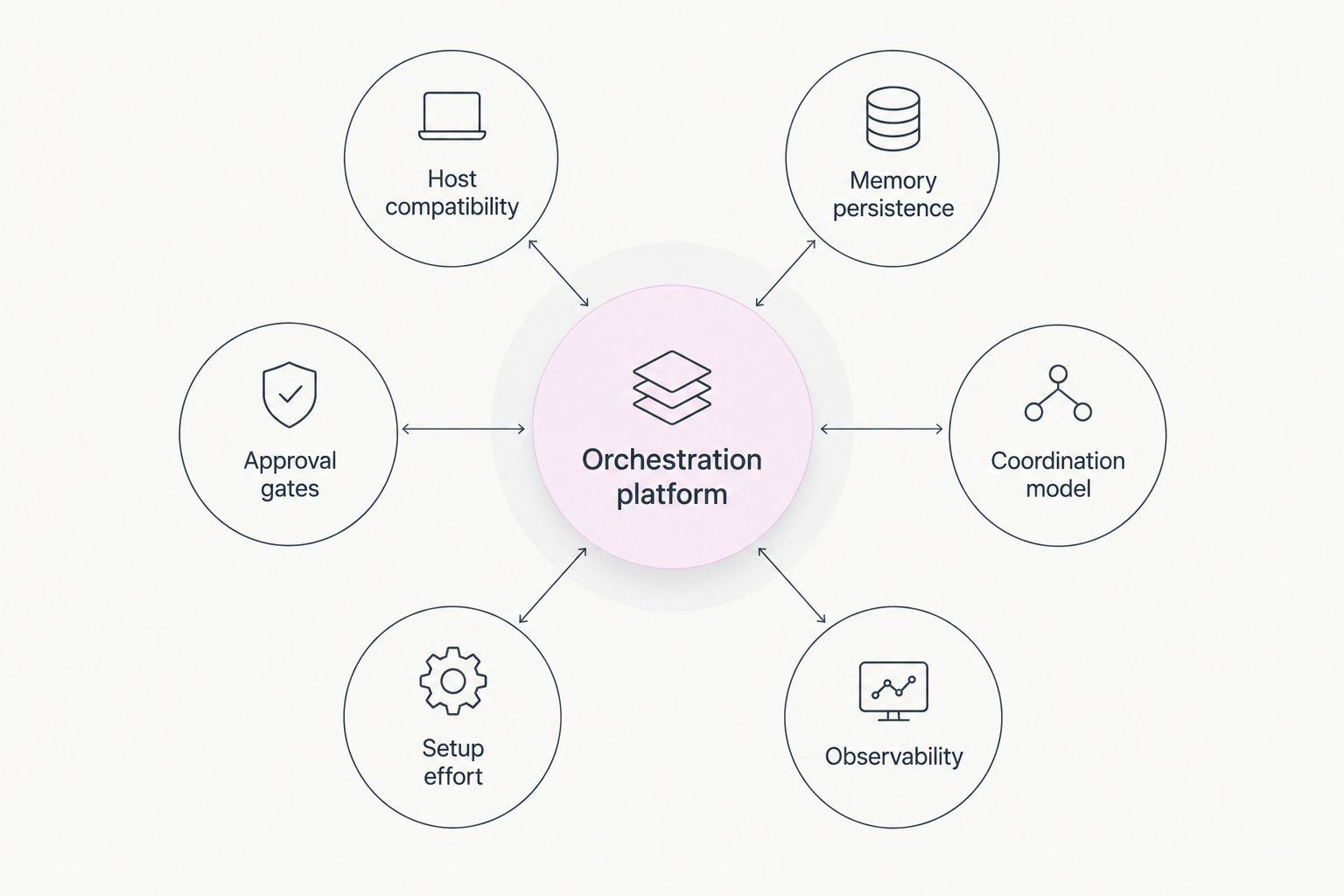
What makes the best AI agent orchestration platform
- Host compatibility: The platform should work with the AI hosts and models your team already uses rather than forcing a complete workflow change.
- Memory persistence: Agents need access to relevant prior context so each task does not begin from an empty state.
- Human-approval gates: A person should be able to review consequential actions before an agent completes them.
- Coordination model: The platform must support the structure your workflow needs, whether that is a sequence, a role-based crew or a state graph.
- Setup effort: A packaged system reduces implementation work, while a code-first framework offers more control at the cost of engineering time.
- Observability: Teams need a clear record of agent actions, tool use, handoffs and failures.
These six criteria separate an orchestration platform from a basic chatbot or isolated automation. A chatbot answers a prompt. An orchestration platform coordinates persistent work across agents, tools and review steps.
AI agent orchestration platforms at a glance
| Platform | Best for | Standout feature | Key limitation |
|---|---|---|---|
| Agentik OS | Teams working inside Claude, ChatGPT, Cursor or Codex | Installable agent systems with shared memory and approval gates | Depends on an MCP-compatible AI host |
| LangGraph | Developers building custom agent graphs | Graph-based control over agent state and transitions | Requires engineering and ongoing maintenance |
| CrewAI | Role-based agent teams | Agents organized around roles, tasks and handoffs | Complex workflows still require code |
| Microsoft AutoGen | Enterprise research and experimentation | Multi-agent conversations and collaboration patterns | Technical setup is heavier than visual builders |
| n8n | Existing automation stacks | Agent steps inside visual workflows | Less focused on deep multi-agent coordination |
| Relevance AI | No-code business teams | Visual agent building and templates | Less control than code-first frameworks |
1. Agentik OS: best for teams inside existing AI hosts
This marketplace provides installable agent systems for content and growth operations. Shared memory lets those systems work from common context, while human-approval gates keep people involved in the workflow.
The key distinction is where the orchestration happens. Instead of sending users into another standalone dashboard, the systems run inside supported AI hosts through MCP. That makes it a strong fit for companies that already treat Claude, ChatGPT, Cursor or Codex as an operating environment for daily work.
Agentik OS pros:
- Runs inside Claude, ChatGPT, Cursor and Codex through MCP
- Offers installable systems rather than an empty orchestration framework
- Shares memory across agent systems
- Includes human-approval gates
Agentik OS cons:
- Requires a compatible AI host
- Offers less low-level control than building a custom graph in code
- Focuses on packaged content and growth systems rather than unrestricted framework development
Best for: Companies and teams that want to automate content and growth operations without creating every agent, memory layer and approval step from scratch.
Verdict: Buy. This is the default 2026 choice when your team wants agents to work inside its existing AI host.
2. LangGraph: best for custom agent graphs
LangGraph is a code-first framework from the LangChain ecosystem. Developers define workflows as graphs containing states, transitions and conditional paths, giving them direct control over how an agent proceeds, pauses or revisits an earlier step.
That graph structure fits workflows that cannot be represented as a simple linear sequence. A developer can model branching decisions, maintain state between nodes and determine what happens when an agent needs another attempt. The trade-off is ownership: your team has to build, test and maintain the resulting application.
LangGraph pros:
- Supports stateful and cyclic workflows
- Gives developers direct control over transitions and branching
- Fits applications that need custom coordination logic
- Works within the broader LangChain ecosystem
LangGraph cons:
- Requires software development skills
- Human review interfaces must be implemented for the specific application
- Deployment, monitoring and maintenance remain your responsibility
Best for: Engineering teams building a proprietary agent application with workflow logic that packaged systems cannot represent.
Verdict: Buy if custom control matters more than implementation speed. Skip if you do not have developers assigned to the orchestration layer.
3. CrewAI: best for role-based agent collaboration
CrewAI models an agent team through roles, tasks and collaboration. This makes the framework easy to understand when your process already has recognizable responsibilities such as research, analysis, drafting and review.
Its role-based structure is more intuitive than a graph for some teams. Each agent receives a responsibility, and the workflow defines how work moves between those responsibilities. The framework still requires code, so a clear organizational metaphor does not remove the need for engineering.
CrewAI pros:
- Maps naturally to workflows with specialized roles
- Makes task ownership and agent responsibilities explicit
- Supports multi-agent handoffs
- Uses a code-first approach that developers can extend
CrewAI cons:
- Requires development and maintenance
- Role definitions can become cumbersome in highly dynamic workflows
- Approval interfaces depend on the implementation around the framework
Best for: Developer-led teams whose workflows already resemble a crew of specialists completing defined tasks.
Verdict: Buy for clear role-based processes. Hold if your workflow depends on complex state transitions rather than stable responsibilities.
4. Microsoft AutoGen: best for enterprise research
Microsoft AutoGen is a framework for applications in which agents communicate, use tools and collaborate on tasks. Its conversational model is useful when agents need to propose, critique or refine work through multiple exchanges.
AutoGen is strongest as a technical foundation for experimentation. It gives research and engineering teams room to test different agent configurations, but it does not remove the work required to turn a prototype into an operational system with permissions, monitoring and human review.
Microsoft AutoGen pros:
- Supports conversations involving multiple agents
- Fits research into agent collaboration patterns
- Can connect agents with tools and human participants
- Appeals to teams already working in the Microsoft development ecosystem
Microsoft AutoGen cons:
- Requires technical implementation
- Production controls depend on the surrounding application
- Adds more setup than a packaged or no-code platform
Best for: Enterprise research and engineering teams experimenting with multi-agent interaction before defining a production architecture.
Verdict: Hold for production adoption. Buy when the immediate goal is structured multi-agent research.
5. n8n: best for existing automation stacks
n8n is a workflow automation platform with visual nodes for connecting applications, logic and AI steps. It is a practical option when agent behavior is one part of a larger automation that already moves data between business systems.
The visual workflow makes dependencies visible and reduces the amount of glue code required for common integrations. Its broad automation scope is also its limitation: teams seeking advanced multi-agent state management can outgrow a workflow built mainly from connected nodes.
n8n pros:
- Combines agent steps with broader workflow automation
- Uses a visual builder for connections and logic
- Fits teams that already maintain n8n workflows
- Connects AI activity with non-AI business processes
n8n cons:
- Agent orchestration is one feature within a general automation platform
- Complex state and agent collaboration require careful workflow design
- Visual workflows can become difficult to manage as branching increases
Best for: Operations teams adding agent tasks to an established automation environment.
Verdict: Buy if n8n already coordinates your business systems. Skip if advanced multi-agent behavior is the primary requirement.
6. Relevance AI: best for no-code teams
Relevance AI provides a visual environment for creating agents and organizing automated work. It targets business users who need to configure agent behavior without building a framework-level application.
Templates and visual controls shorten the path from idea to an operational workflow. That convenience comes with less low-level control than LangGraph, CrewAI or AutoGen, especially when an application needs unusual state transitions or custom infrastructure.
Relevance AI pros:
- Gives non-developers a visual building experience
- Reduces the code needed for common agent workflows
- Supports reusable agent configurations
- Fits rapid internal workflow development
Relevance AI cons:
- Offers less control than code-first frameworks
- Complex custom logic can exceed the visual model
- Teams still need governance around tools, data and actions
Best for: Business teams that need a configurable agent workflow without assigning engineers to build the orchestration foundation.
Verdict: Buy for straightforward no-code workflows. Wait if your requirements include unusual infrastructure or deeply customized state management.
How we ranked these platforms
The ranking gives equal attention to implementation and operational control. A platform does not rank highly merely because it can connect multiple agents; it also needs a credible approach to context, human oversight and failure analysis.
The order reflects distinct buyer needs in 2026. Packaged systems rank first for teams seeking immediate operational use. Code-first frameworks rank higher when custom architecture is the requirement. Visual automation tools rank well when agent work must connect to an existing set of business processes.
No single option wins every criterion. LangGraph gives developers more control than a packaged marketplace, but it demands more engineering. Relevance AI removes more code, but it offers less low-level flexibility. n8n connects agents to broader automations, while CrewAI makes role-based collaboration easier to model.
Which AI agent orchestration platform should you choose?
Agentik OS is the best AI agent orchestration platform for teams that want installable content and growth systems inside Claude, ChatGPT, Cursor or Codex. It removes the need to build the full orchestration layer while retaining shared memory and human review.
Choose LangGraph when your application needs custom state transitions and your developers will maintain the code. Choose CrewAI when agent roles mirror a stable team process. Choose Microsoft AutoGen for enterprise research, n8n for an existing automation stack, or Relevance AI when no-code configuration is the priority.
The deciding question for 2026 is simple: do you want to own an orchestration codebase or operate an installable agent system? Answer that before comparing secondary features.
Browse installable agent systems
See agent systems for content and growth operations inside supported AI hosts.
FAQ
What is an AI agent orchestration platform?
An AI agent orchestration platform coordinates agents, tools, memory and human review across a workflow. It determines how tasks move between agents and what happens when an action fails or needs approval.
What is the best AI agent orchestration platform in 2026?
Agentik OS is the best 2026 option for teams that want installable content and growth agent systems inside Claude, ChatGPT, Cursor or Codex. LangGraph is better when developers need full control over a custom agent graph.
Is Agentik OS better than LangGraph?
Agentik OS is better for teams that want packaged agent systems with shared memory and approval gates. LangGraph is better for developers building custom state graphs and application logic.
Which AI agent orchestration platform is best for no-code teams?
Relevance AI is the strongest no-code choice in this ranking because it provides a visual environment for configuring agent workflows. Teams should choose a code-first framework instead when custom state management is essential.
Does an AI agent orchestration platform need shared memory?
Shared memory is necessary when multiple agents need consistent context across related tasks. Without it, teams must repeatedly supply background information or build a separate persistence layer.
Why are human-approval gates important for AI agents?
Human-approval gates let a person review consequential actions before completion. They are especially important when an agent uses external tools or changes an operational workflow.
Is n8n an AI agent orchestration platform?
n8n can orchestrate agent steps within broader visual automations, although it is a general workflow platform rather than an agent-only framework. It fits teams that already use n8n to connect business systems.
How much does an AI agent orchestration platform cost in 2026?
Costs vary between open-source frameworks, managed visual builders and installable agent systems. Check each platform's current terms and include development, hosting and maintenance effort in the comparison.
One last thing
Do not begin with the longest feature list. Begin with the operating model. If your team wants to build and maintain agent logic, shortlist LangGraph, CrewAI and AutoGen; if it wants agents inside existing work environments, choose a packaged system; if it wants agents inside established automations, evaluate n8n.
That split removes most unsuitable options before a technical review begins. In 2026, the best orchestration decision is the one that matches who will own the system after launch, not the one with the most agent demos.