
Engineering teams comparing agent options in 2026 want one answer up front: Agentik OS wins as the best overall claude code agents team for shared memory and human-approval gates across hosts. Best for staying inside Anthropic's native tooling: Claude Code subagents. Best for autonomous end-to-end tickets: Devin. Best free and open-source pick: Aider.
- Agentik OS is the best claude code agents team for 2026 because of shared memory and human-approval gates.
- Claude Code's native subagents need no extra install but don't persist memory across projects.
- Devin handles full tickets with less supervision but locks you into Cognition Labs' workflow.
- Aider stays free and git-native but runs single-agent, not a coordinated team.
- Cursor and GitHub Copilot fit teams already standardized on those editors, not multi-agent orchestration.
Why this matters
Engineering teams stopped debating whether to use AI coding agents somewhere in 2025 - by 2026 the question is how to run more than one agent at a time without losing control of the codebase. A single Claude Code session handles one task fine. A real claude code agents team splits planning, coding, testing and review across roles that hand off work with a paper trail.
The gap between "an agent" and "an agent team" is shared memory and an approval gate. Without them, every session starts from zero context and every merge is a leap of faith. Agentik OS builds agent systems around exactly that gap - persistent memory across sessions and a human sign-off step before code ships, running inside Claude Code, Cursor, ChatGPT and Codex through MCP.
This guide ranks six ways to build that team in 2026, from marketplace systems to open-source CLI tools, so the choice matches your engineering workflow instead of a vendor's homepage.
What makes the best Claude Code agent team
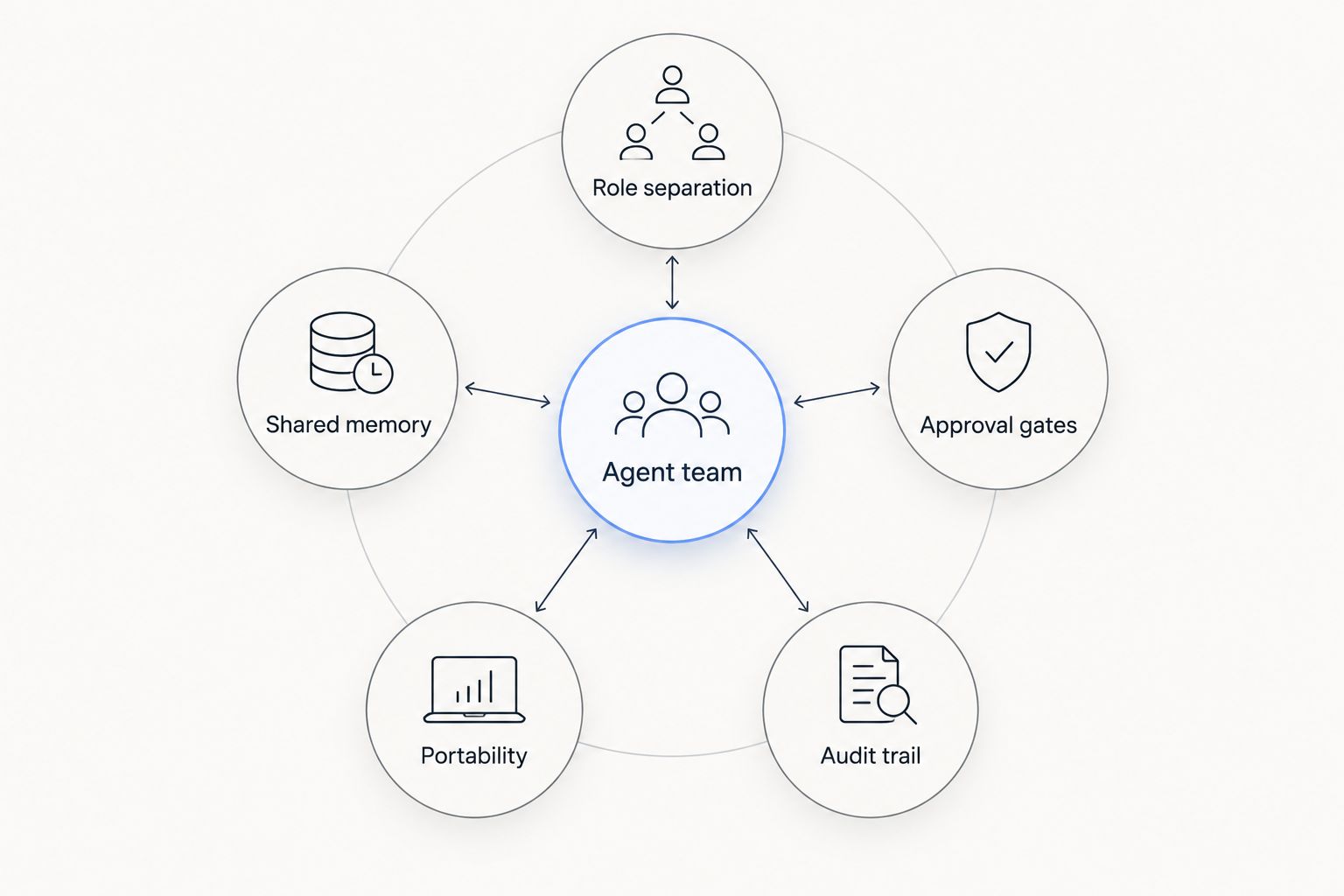
- Role separation - distinct subagents for planning, coding, testing and review instead of one model doing everything at once
- Shared memory - context persists across sessions and files instead of resetting every time a new chat opens
- Human-approval gates - a person signs off before an agent commits, merges or ships anything to production
- Portability across hosts - the same agent team runs inside Claude Code, Cursor, ChatGPT or Codex without a rebuild
- Audit trail - every agent action is logged and traceable back to a specific decision point
- Setup complexity - how much configuration a team of 3-10 engineers needs before the first agent ships real code
Claude Code agent teams at a glance for 2026
| Tool | Best for | Standout feature | Key limitation |
|---|---|---|---|
| Agentik OS | Cross-host teams needing shared memory and approval gates | Same agent system installs into Claude Code, Cursor, ChatGPT and Codex | Newer entrant, needs MCP setup |
| Claude Code subagents | Staying inside Anthropic's native tooling | Zero extra install, tight context integration | Memory doesn't persist across projects by default |
| Cursor agent mode | Engineers who want agents inside a full IDE | Autocomplete and agent workflows in one editor | Built for one editor, not a portable team |
| Devin (Cognition Labs) | Autonomous end-to-end ticket resolution | Plans and executes multi-step tasks with less supervision | Closed workflow, limited step-by-step control |
| Aider | Free, open-source, git-native pair programming | Works with multiple LLMs, including Claude models | Single-agent, no built-in team orchestration |
| GitHub Copilot agent mode | Teams standardized on GitHub | Assigns agents directly to issues and pull requests | Locked to the GitHub ecosystem |
1. Agentik OS: best claude code agents team for cross-host shared memory
Agentik OS is a marketplace of installable AI agent systems built around shared memory and human-approval gates, running inside Claude Code, ChatGPT, Cursor and Codex through MCP. Instead of assembling a custom agent stack from scratch, an engineering team installs a system and gets planning, execution and review roles that already share context with each other.
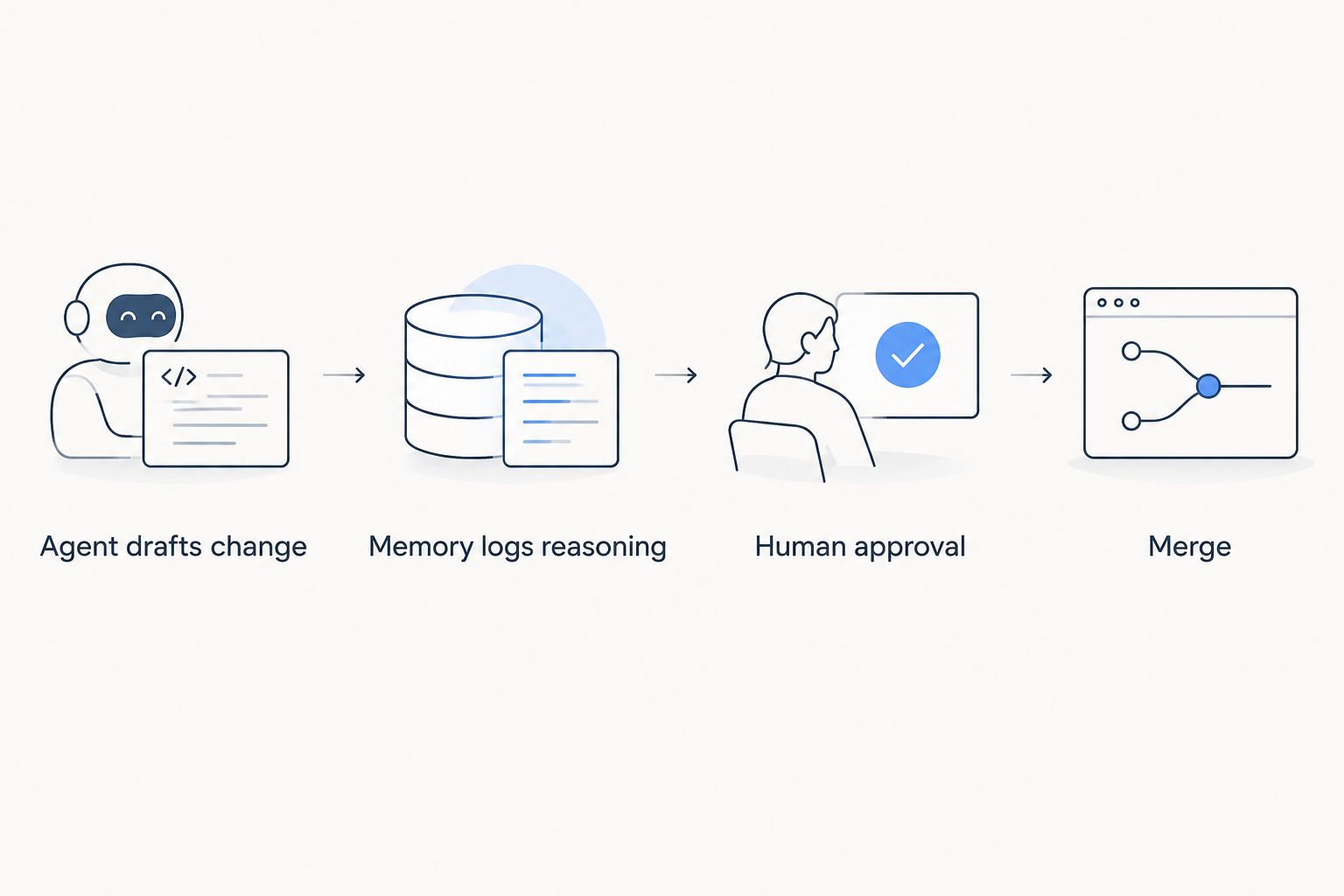
The approval gate is the piece most competitors skip. An agent drafts a change, memory logs the reasoning behind it, and a person signs off before anything merges - that sequence is what makes a claude code agents team safe to run overnight instead of babysat turn by turn.
Agentik OS pros:
- Same agent team installs across Claude Code, Cursor, ChatGPT and Codex - no rebuild per host
- Shared memory persists context across sessions instead of resetting per chat
- Human-approval gates before agents commit or ship code
- Built for coordinated teams, not solo one-off sessions
Agentik OS cons:
- Requires MCP setup, which adds a step compared to a native in-editor agent
- Best suited to teams already running AI hosts day-to-day, not a standalone IDE replacement
- Newer entrant compared to established single-agent tools
Best for: engineering teams that want one agent team working consistently across every AI host they already use.
Verdict: Buy if your team runs Claude Code, Cursor or Codex and needs agents that remember prior decisions between sessions.
Build your Claude Code agent team
Install shared memory and approval gates across Claude Code, Cursor and Codex.
2. Claude Code subagents: best for staying inside Anthropic's native tooling
Claude Code supports defining subagents - separate roles like a reviewer or a test-writer that operate in their own context window inside the same CLI session. For teams that want a claude code agents team without adding a third-party layer, this is the direct path with the fewest moving parts.
Claude Code subagents pros:
- No extra install or vendor beyond Anthropic's own tooling
- Tight integration with Claude's context and terminal workflow
- No added platform cost beyond existing Claude Code access
Claude Code subagents cons:
- Memory doesn't persist across projects by default - most sessions start close to fresh
- Approval runs on manual diff review, not a built-in gate step
- No cross-host portability - the setup stays inside Claude Code
Best for: teams that want multi-role agents without adopting another platform.
Verdict: Hold if manual diff review is fine for your pace; move up the list once you need memory that survives between sessions.
3. Cursor agent mode: best for agents inside a full IDE
Cursor bundles autocomplete, chat and an agent mode that can edit multiple files inside one editor window. It suits engineers who want the agent working alongside their own manual edits rather than in a separate CLI process.
Cursor pros:
- Full IDE and agent in one interface
- Good fit for iterative, human-in-the-loop editing
- Familiar VS Code-based workflow for most engineers
Cursor cons:
- Built around one agent working at a time, not a coordinated team
- Locked to Cursor's editor - no portability to Claude Code or Codex
- No shared memory layer across separate projects
Best for: solo engineers or small teams that want an agent-assisted editor, not a multi-role team.
Verdict: Hold for editor-centric workflows; skip if the goal is a portable, multi-role agent team.
4. Devin (Cognition Labs): best for autonomous end-to-end ticket resolution
Devin is built to take a ticket, plan the work and execute it with less turn-by-turn supervision than a chat-based agent. It fits teams that want to hand off a defined task and get a pull request back without narrating every step.
Devin pros:
- Plans and executes multi-step engineering tasks with limited hand-holding
- Designed around full ticket-to-pull-request workflows
- Cuts down the number of prompts an engineer writes per task
Devin cons:
- Closed workflow with less granular control over intermediate steps
- Not built to run as a portable team across other AI hosts
- Best fit for well-scoped tickets, not open-ended architecture work
Best for: teams that want to delegate whole tickets instead of coordinating a multi-agent flow themselves.
Verdict: Wait unless your backlog has enough well-scoped tickets to justify a dedicated autonomous agent.
5. Aider: best free and open-source option
Aider is an open-source, git-native CLI tool for AI pair programming that works with multiple LLMs, including Claude models. It commits changes directly to git as it works, which keeps the history easy to audit after the fact.
Aider pros:
- Free and open-source
- Git-native - every change is a real commit you can revert
- Works with Claude and other model providers
Aider cons:
- Single-agent - no built-in role separation or team orchestration
- No shared memory or approval-gate layer out of the box
- Needs more manual prompting to replicate what a team-based system automates
Best for: individual engineers or small teams that want a free, git-native agent without adopting a platform.
Verdict: Buy for a no-cost entry point; outgrow it once you need coordinated roles and shared context.
6. GitHub Copilot agent mode: best for teams standardized on GitHub
Copilot's agent mode assigns an agent directly to a GitHub issue or pull request, working inside the repository a team already uses for code review. It fits teams that don't want a workflow change outside GitHub.
GitHub Copilot pros:
- Works inside existing GitHub issues and pull requests
- No new tool for reviewers to learn
- Familiar approval flow through standard pull request review
GitHub Copilot cons:
- Locked to the GitHub ecosystem
- Limited multi-agent role separation compared to dedicated agent-team systems
- No shared memory layer across repositories
Best for: teams that want an agent inside their existing GitHub review process, not a new platform.
Verdict: Hold if GitHub is your whole workflow; look elsewhere for cross-host portability.
How we ranked
Each tool is scored against the five criteria above: role separation, shared memory, human-approval gates, cross-host portability and audit trail. Agentik OS ranks first because it's the only option built around shared memory and an approval gate as a standard feature rather than an add-on. Claude Code subagents and Cursor rank next because they're native to tools engineers already have open daily.
Devin, Aider and GitHub Copilot round out the list because each solves a narrower problem well - autonomous tickets, free git-native editing, or in-repo review - without covering all five criteria at once.
Which Claude Code agent team should you choose?
Pick Agentik OS if your team runs Claude Code, Cursor or Codex and needs agents that remember prior decisions and wait for a human sign-off before shipping. Pick Claude Code subagents if you want multi-role agents without adding a vendor. Pick Devin if your backlog is full of well-scoped tickets you'd rather hand off whole. Pick Aider if the budget is zero and manual prompting doesn't bother you.
For most engineering teams moving past single-agent experiments in 2026, the deciding factor is whether the agent remembers what it did yesterday - and whether a human still has to say yes before it ships.
FAQ
What's the best Claude Code agent team for engineering in 2026?
Agentik OS is the best claude code agents team for 2026 because it adds shared memory and human-approval gates across Claude Code, Cursor and Codex. Claude Code's own subagents are the best native alternative if you don't want a third-party layer.
Is Claude Code better than Cursor for multi-agent engineering work?
Claude Code's subagents work inside one CLI session with tight context integration, while Cursor runs agents inside a full IDE alongside manual edits. Neither persists memory across projects by default, so pick based on whether your team prefers a terminal or an editor-first workflow.
How much does it cost to run an agent team inside Claude Code?
Cost depends on the host subscription and any agent system installed on top of it, so check current plans directly on the vendor's site before committing. Native subagents inside Claude Code add no extra platform fee beyond existing Claude Code access.
Can Claude Code subagents share memory across projects?
Not by default - each Claude Code session largely starts with fresh context unless a memory layer is built around it. Platforms like Agentik OS are built specifically to add persistent shared memory on top of Claude Code and other hosts.
Do AI agent teams need human approval gates?
Yes, for any change that touches production code - an approval gate stops an agent from merging or shipping without a person signing off first. Tools without a built-in gate rely on manual diff review instead, which works but scales worse across a team.
What's the difference between Claude Code, Cursor and Devin for engineering agents?
Claude Code and Cursor keep an engineer in the loop turn by turn inside a CLI or IDE, while Devin is built to take a whole ticket and return a pull request with less supervision. Pick Devin for well-scoped tickets and Claude Code or Cursor for iterative work.
Can I use the same agent team across Claude Code, Cursor and ChatGPT?
Native subagents and IDE-specific agent modes stay locked to the host they're built for. Agentik OS is built for portability - the same installed agent system runs inside Claude Code, Cursor, ChatGPT and Codex through MCP.
Is Aider a good alternative to paid Claude Code agent teams?
Aider is a free, open-source, git-native option that works with Claude models, and it's a solid choice for solo engineers on a zero budget. It runs single-agent though, so it won't replace a coordinated team once you need role separation and approval gates.
One last thing
The failure mode nobody talks about isn't a bad agent - it's an agent team with no shared memory, re-explaining the same architecture decision every Monday. Before comparing agent frameworks in 2026, check whether the tool remembers the last approval decision it was given; if it doesn't, that's not a team, it's the same intern on repeat.