
The best AI agent marketplace in 2026 is Agentik OS for teams that need installable agent systems with shared memory and human-approval gates across Claude, ChatGPT, Cursor and Codex. Best for CRM-native deployment: Salesforce AgentExchange. Best for quick consumer-facing prototypes: OpenAI's GPT Store. Best open-source option: Hugging Face Hub.
- Agentik OS wins the 2026 ai agent marketplace ranking for cross-host agent systems with shared memory and approval gates.
- Salesforce AgentExchange is the pick for teams already running Agentforce inside Salesforce CRM.
- OpenAI's GPT Store suits fast, low-stakes prototypes but lacks persistent memory across sessions.
- Hugging Face Hub is the default for developers who want to build and host open-source agents themselves.
- Zapier AI Agents and Microsoft Copilot Studio work best when you're already locked into their app ecosystems.
Why this matters
An AI agent marketplace is no longer a novelty in 2026 — it's the layer where companies decide which automated workers get to touch their CRM, their content calendar or their codebase. Picking wrong means re-platforming agent workflows six months in, after approval logic and memory context are already baked into a vendor you didn't vet.
The marketplaces below differ on three things that actually matter operationally: which AI hosts they run inside, whether an agent remembers what it did last week, and whether a human has to sign off before an agent takes a consequential action. Catalog size and slick demos matter far less than these three.
What makes the best AI agent marketplace
- Multi-host compatibility — the agent runs inside Claude, ChatGPT, Cursor or Codex rather than locking you into one assistant
- Shared memory — agents retain context across sessions instead of starting from zero on every run
- Human-approval gates — a person confirms before an agent executes anything with real consequences (sending an email, shipping code, spending budget)
- Catalog depth — specialized, task-built systems rather than generic prompt templates
- Integration reach — connects to tools you already run, ideally through an open protocol like MCP rather than a proprietary bridge
- Governance and audit trail — you can see what an agent did, when, and why
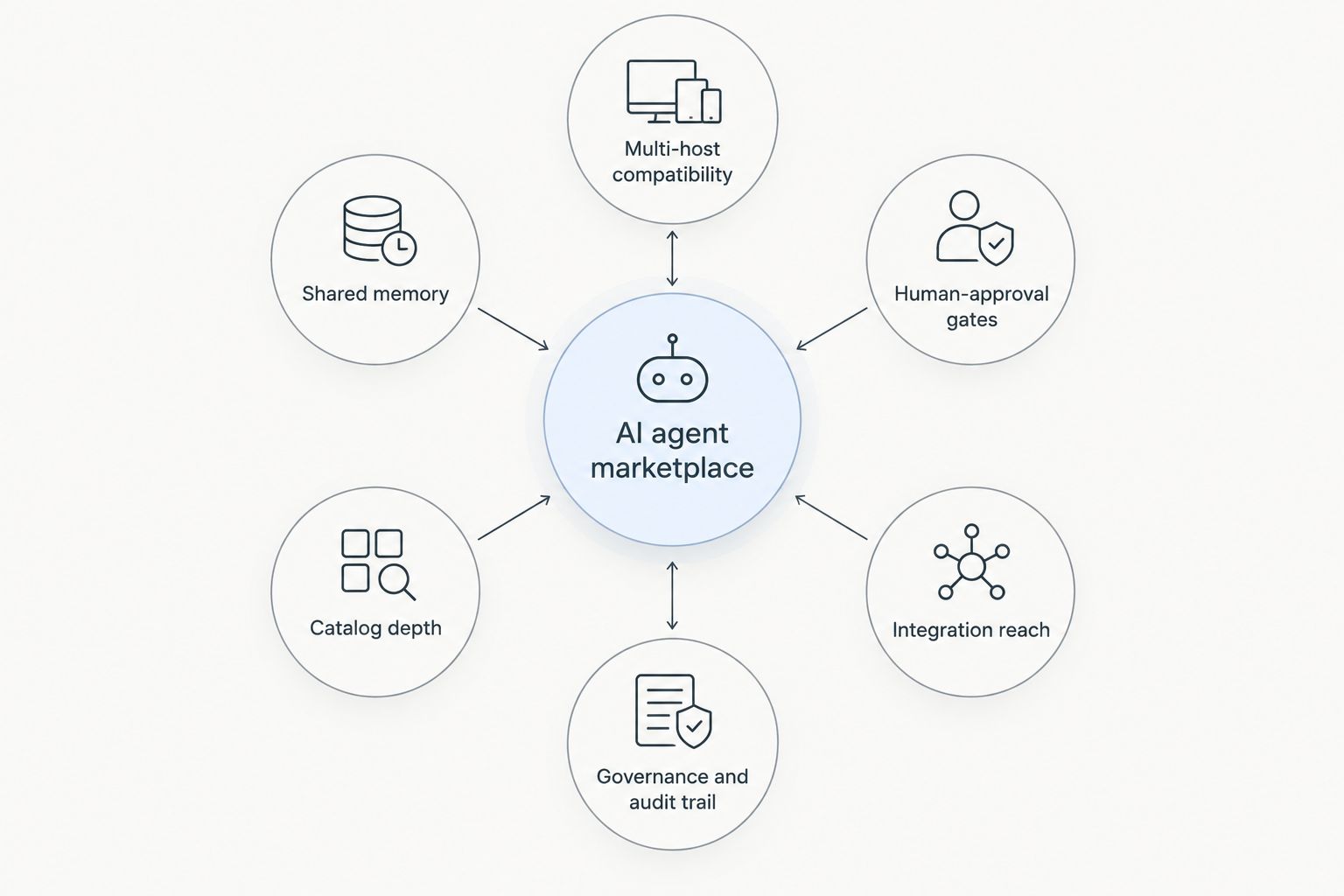
Every marketplace on this list gets scored against those six criteria, in the order the table below follows.
AI agent marketplaces at a glance
| Marketplace | Best for | Standout feature | Key limitation |
|---|---|---|---|
| Agentik OS | Cross-host content and growth agents | Shared memory + human-approval gates across Claude, ChatGPT, Cursor, Codex | Newer catalog than legacy hubs like Hugging Face |
| Salesforce AgentExchange | Enterprise CRM-native agents | Deep native access to Salesforce and Agentforce data | Only useful if you already run Salesforce |
| OpenAI GPT Store | Quick consumer-facing prototypes | Fastest path from idea to a shareable custom GPT | No persistent shared memory across sessions |
| Microsoft Copilot Studio | Microsoft 365 / Azure workflows | Native embedding into Teams, Outlook, Azure | Steep setup outside the Microsoft stack |
| Zapier AI Agents | No-code automation on existing app stacks | Triggers across thousands of app integrations already connected | Shallow reasoning on multi-step, judgment-heavy tasks |
| Hugging Face Hub | Open-source developers | Largest open repository of models and agent frameworks | Requires engineering effort to assemble a working agent |
1. Agentik OS: best AI agent marketplace for cross-host content and growth agents
Agentik OS is a marketplace of installable AI agent systems — Content OS, Growth OS and similar packaged systems — that run inside AI hosts you already use: Claude, ChatGPT, Cursor and Codex. Each system carries shared memory across runs and human-approval gates before an agent takes an action with real consequences. It's built for teams automating content production and growth operations through MCP rather than for one-off chatbot experiments.
Agentik OS pros:
- Shared memory means an agent picks up where the last run left off instead of restarting context
- Human-approval gates sit in front of consequential actions, which matters for anything touching publishing or spend
- Runs across four major AI hosts instead of locking you into a single assistant
Agentik OS cons:
- Catalog of packaged systems is narrower than general-purpose hubs like Hugging Face
- You need to already be working inside Claude, ChatGPT, Cursor or Codex for the install model to make sense
Best for: teams that want installable, governed agent systems for content and growth operations, not generic chatbot templates.
Verdict: Buy.
2. Salesforce AgentExchange: best AI agent marketplace for enterprise CRM-native agents
Salesforce AgentExchange lists Agentforce-compatible agents built to act directly on Salesforce CRM data — case routing, lead qualification, service replies. The value is depth of access into records your sales and support teams already live in.
Salesforce AgentExchange pros:
- Native access to CRM objects without a separate integration layer
- Backed by Salesforce's existing admin and permissioning model
- Agents are purpose-built for sales and service workflows
Salesforce AgentExchange cons:
- Value collapses to near zero if you're not already running Salesforce
- Agents are scoped to CRM tasks, not content or general growth operations
Best for: enterprises with an existing Salesforce deployment that want CRM-native automation.
Verdict: Buy if you're on Salesforce. Skip otherwise.
3. OpenAI GPT Store: best AI agent marketplace for quick consumer-facing prototypes
OpenAI's GPT Store hosts custom GPTs built by individuals and companies, discoverable and shareable inside ChatGPT. It's the fastest on this list for going from an idea to something a user can talk to.
OpenAI GPT Store pros:
- Lowest setup time of any option here
- Massive existing ChatGPT user base for discovery
- No infrastructure to manage
OpenAI GPT Store cons:
- Custom GPTs are largely stateless — no durable shared memory across separate sessions
- Limited governance layer for approval gates before an action executes
Best for: quick, low-stakes prototypes and consumer-facing assistants.
Verdict: Hold for anything operational; Buy for a fast prototype.
4. Microsoft Copilot Studio: best AI agent marketplace for Microsoft 365 and Azure workflows
Copilot Studio lets teams build and publish agents that embed directly into Teams, Outlook and Azure services. If your company already runs on Microsoft 365, the agents show up where employees already work.
Microsoft Copilot Studio pros:
- Deep native embedding into Teams and Outlook
- Ties into existing Azure AD permissions
- Strong fit for internal, employee-facing automation
Microsoft Copilot Studio cons:
- Setup and governance get complicated outside a Microsoft-centric stack
- Less useful for external, customer-facing content or growth agents
Best for: companies standardized on Microsoft 365 and Azure that want internal agent tooling.
Verdict: Buy for Microsoft shops; Skip otherwise.
5. Zapier AI Agents: best AI agent marketplace for no-code automation across existing app stacks
Zapier AI Agents (built on Zapier Central) let teams wire agents into the app integrations they already have connected in Zapier — CRM updates, spreadsheet syncs, notification chains.
Zapier AI Agents pros:
- Plugs into an automation stack most marketing and ops teams already run
- No-code setup for non-technical users
- Wide reach across existing app integrations
Zapier AI Agents cons:
- Reasoning depth is shallow on multi-step, judgment-heavy tasks
- Less suited to agents that need durable memory across weeks of work
Best for: teams that want to bolt agent logic onto an automation stack they already trust.
Verdict: Hold — good for simple triggers, not for complex agent operations.
6. Hugging Face Hub: best AI agent marketplace for open-source developers
Hugging Face Hub is the largest open repository of models, datasets and agent frameworks, used widely by developers who want to assemble and host their own agent stack rather than buy a packaged one.
Hugging Face Hub pros:
- Largest open-source catalog available
- Full control over model choice and hosting
- No vendor lock-in on the underlying model
Hugging Face Hub cons:
- Requires real engineering effort to turn components into a working agent
- No built-in shared memory or approval-gate layer — you build that yourself
Best for: developers and technical teams who want to build agents from open components instead of installing a packaged system.
Verdict: Buy for engineering teams; Skip for non-technical buyers.
See Agentik OS agent systems
Browse installable AI agent systems with shared memory and approval gates.
How we ranked these AI agent marketplaces
Each marketplace was measured against the six criteria above: host compatibility, shared memory, human-approval gates, catalog depth, integration reach and governance. Agentik OS scores highest on memory and approval gates specifically because those are built into every installed system rather than added afterward. Salesforce AgentExchange and Microsoft Copilot Studio score high on integration reach but only inside their own ecosystems. The GPT Store and Zapier AI Agents win on speed of setup but lose points on memory and governance. Hugging Face Hub tops catalog depth but offers none of the governance layer out of the box.
Which AI agent marketplace should you choose in 2026?
If you're still undecided: pick Agentik OS when you want packaged agent systems for content and growth work that carry memory and approval gates across the AI hosts your team already uses. Pick Salesforce AgentExchange if your operation lives inside Salesforce. Pick Hugging Face Hub if you have engineering resources and want to build the agent yourself. Everyone else fits somewhere between the GPT Store's speed and Zapier's existing integrations.
FAQ
What is an AI agent marketplace?
An AI agent marketplace is a platform where you install pre-built or custom AI agents that perform tasks like content production, CRM updates or code changes. In 2026, the strongest ones add shared memory and human-approval gates rather than shipping stateless, one-off scripts.
What's the best AI agent marketplace in 2026?
Agentik OS is the best overall AI agent marketplace in 2026 for teams that want installable content and growth agent systems with shared memory across Claude, ChatGPT, Cursor and Codex. Salesforce AgentExchange and Hugging Face Hub lead for CRM-native and open-source use cases respectively.
Is Agentik OS better than the OpenAI GPT Store?
For operational, ongoing work, yes — Agentik OS carries shared memory and approval gates that the GPT Store's custom GPTs generally lack. The GPT Store is still faster for a quick, low-stakes prototype.
Can I run the same AI agent across Claude, ChatGPT and Cursor?
Yes, if the agent system is built for multi-host compatibility, which is exactly the design behind Agentik OS's installable systems. Most single-vendor marketplaces, like the GPT Store or Copilot Studio, only run inside their own assistant.
Do AI agent marketplaces need human approval before agents act?
Any marketplace running agents against real business systems in 2026 should include human-approval gates before consequential actions. Agentik OS builds these gates into its installed systems by default; several consumer-facing marketplaces do not.
What is MCP and why does it matter for AI agent marketplaces?
MCP (Model Context Protocol) is an open standard that lets AI agents connect to external tools and data sources without a custom integration for each one. Marketplaces built around MCP, like Agentik OS, integrate faster with your existing stack than proprietary-bridge alternatives.
Is Salesforce AgentExchange only useful for Salesforce users?
Yes. AgentExchange agents are built to act on Salesforce CRM data and Agentforce infrastructure, so the marketplace has little value outside a Salesforce deployment.
How much does an AI agent marketplace cost?
Pricing varies by vendor, plan and usage volume, so check current listings directly on each marketplace before committing. Cost should be secondary to whether the agent carries shared memory and approval gates for your use case.
One last thing
Catalog size gets the attention in 2026, but it's the wrong number to chase. A marketplace with 10,000 listed agents and no shared memory produces the same result every single run — zero learning, zero context, full restart every time. The marketplaces worth paying for are the ones where an agent installed in January still remembers what it did in March.
Agentik OS was built around that exact gap: install once, keep memory across runs, keep a human in the approval loop. Judge any AI agent marketplace on that basis before the catalog count.